Leave Your Message

Top 10 Applications of Piezoelectric Load Cell in Modern Industries

The advent of piezoelectric load cells has transformed various industries in recent years. These devices convert mechanical stress into electrical signals. They are compact, precise, and versatile. As a result, they find applications in sectors like manufacturing, robotics, and automotive.

Modern industries rely heavily on these load cells for accurate measurements. They aid in quality control and equipment monitoring. Their integration with smart systems enhances efficiency and reliability. For instance, during the 2026 Canton Fair, advanced technologies like AI will streamline the search for suppliers. This further showcases the importance of precision tools like piezoelectric load cells.

However, challenges persist. Not all industries have embraced this technology. Some may find it costly or complex. Awareness and training are critical for widespread adoption. Reflecting on current practices may reveal opportunities for improvement in how industries utilize these innovative devices.

Top 10 Applications of Piezoelectric Load Cell in Modern Industries

Applications of Piezoelectric Load Cells in Industrial Weighing Systems

In modern industries, piezoelectric load cells play a vital role in weighing systems. These devices convert mechanical stress into electrical signals. Such conversion allows for precise measurements, crucial in industrial applications. For instance, they are commonly used in automated packaging lines. These lines require consistent weight monitoring to ensure product safety and compliance.


Operating in a variety of environments, these load cells face challenges. High temperatures may affect their accuracy. Regular calibration is necessary to maintain optimal performance. The installation can be tricky, requiring skilled professionals to avoid issues. Even small errors in setup may lead to significant discrepancies in weight readings.


Consider food processing plants. Here, accurate weight measurements are essential for inventory and quality control. Piezoelectric load cells help maintain standards but require routine checks. Production schedules can falter if these systems fail. It’s vital to address these potential pitfalls to ensure smooth operations. Understanding these nuances enhances effectiveness in using piezoelectric load cells in industrial weighing systems.

Use of Piezoelectric Load Cells in Structural Health Monitoring

Piezoelectric load cells have gained significant traction in structural health monitoring. These devices convert mechanical stress into electrical signals, enabling precise measurement of forces. Their sensitivity makes them ideal for monitoring large structures like bridges and buildings. They can detect small changes in load and stress, which is crucial for maintenance and safety assessments.

When incorporated into structural health monitoring systems, piezoelectric load cells provide real-time data. This allows engineers to identify potential issues before they become critical. For example, observing gradual changes in load distribution can indicate structural weaknesses. Such early detection can save lives and prevent costly repairs. However, relying solely on these sensors can be problematic. Environmental factors may impact their accuracy, leading to false readings and misinterpretations.

Installation challenges are also significant. Proper placement of load cells is essential to avoid blind spots in monitoring. If misaligned, they may not capture vital data. This highlights the need for thoughtful integration into existing systems. Engineers must balance the cost of high-quality sensors with their effectiveness in monitoring. It’s a complex equation but worthwhile for ensuring the safety and longevity of structures.

Integration of Piezoelectric Load Cells in Robotics and Automation

Top 10 Applications of Piezoelectric Load Cell in Modern Industries

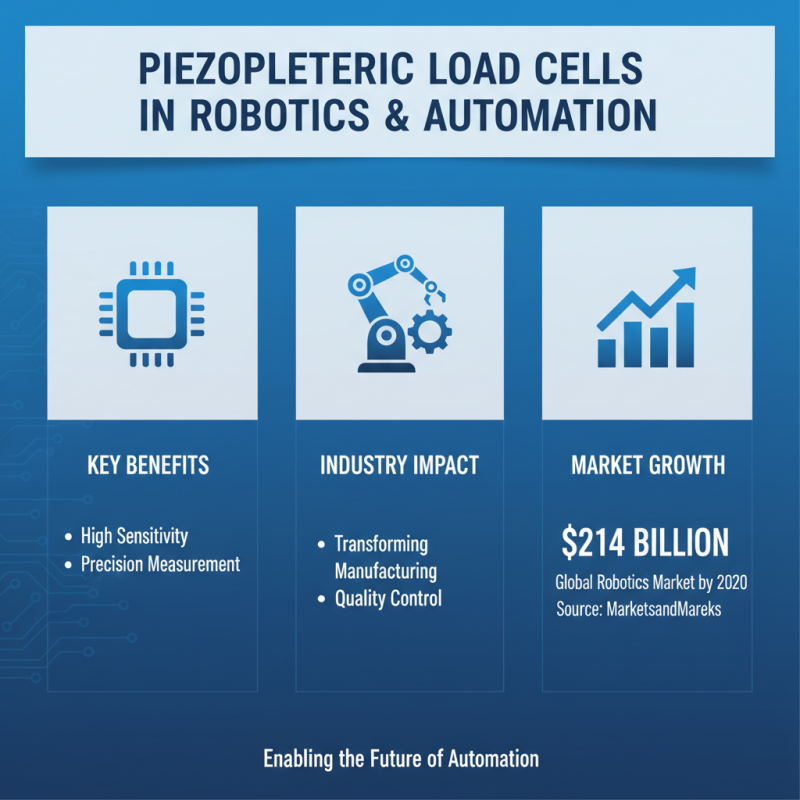
The integration of piezoelectric load cells in robotics and automation is transforming industries. These sensors offer high sensitivity and precision. This is crucial for the evolving landscape of manufacturing. In fact, a recent report by MarketsandMarkets indicates that the global robotics market is projected to reach $214 billion by 2030, with automation playing a key role.

In robotics, piezoelectric load cells enable robots to sense force and apply the right amount of pressure. This is particularly important in delicate assembly tasks. For example, a robotic arm using these sensors can handle fragile components without causing damage. However, as beneficial as these cells are, there are challenges. They can be sensitive to environmental factors, affecting their performance.

**Tip:** Regular calibration can help maintain the accuracy of piezoelectric load cells. Always check the specifications for optimal conditions.

Another application lies in automated quality control systems. These systems can detect anomalies during production. Nevertheless, the technology is still developing. Not all manufacturers have adopted piezoelectric load cells due to cost concerns. Achieving a balance between precision and affordability is essential for wider adoption.

**Tip:** Evaluate lifecycle costs before integrating new technology into existing systems.

Role of Piezoelectric Load Cells in Aerospace Engineering

Piezoelectric load cells play a crucial role in aerospace engineering. They measure forces with high precision. This ability is vital for ensuring safety and performance in flight. In the aerospace industry, these load cells monitor stress and strain during testing. They provide engineers with real-time data, allowing for immediate adjustments. Such responsiveness is critical when dealing with high speeds and varying forces.

These sensors often face harsh conditions. They need to withstand extreme temperatures and vibrations. Designing them for resilience is challenging. Engineers constantly test new materials to improve durability. The integration of piezoelectric load cells in aircraft systems enhances safety. Even minor errors in measurement can lead to significant consequences. Ongoing experimentation helps refine these technologies, pushing boundaries.

Despite advancements, there are areas for improvement. Calibration can be tricky, leading to inconsistent results. Continuous monitoring is necessary to ensure accuracy. Aerospace engineers must regularly reassess their systems. Keeping up with fast-paced innovations can be daunting. Yet, the journey of developing reliable piezoelectric load cells is essential for the future of aerospace superiority.

Top 10 Applications of Piezoelectric Load Cell in Modern Industries - Role of Piezoelectric Load Cells in Aerospace Engineering

Application Area Description Advantages Example Use Case
Aircraft Structural Testing Used for assessing the strength and durability of aircraft components under load. High accuracy, real-time data capture, and minimal drift. Load measurement during wing flex tests.
Flight Control Systems Integration in control systems to monitor and adapt pressure and load. Immediate feedback and improved safety protocols. Real-time load balancing during flight.
Engine Testing Evaluation of engine performance under various load conditions. Provides precise measurements and enhances testing repeatability. Load analysis during engine thrust testing.
Vibration Analysis Monitoring vibrations in critical components to prevent failure. Detects anomalies and enhances maintenance schedules. Monitoring turbine blade vibrations.
Load Monitoring in Automation Automating load measurement in manufacturing operations. Streamlined processes and reduced human error. Load cells integrated in automated assembly lines.
Sensor Calibration Used in calibrating other sensors to ensure accurate measurements. Improves accuracy across various measurement devices. Calibration of pressure sensors in cockpit instruments.
Cargo Weight Measurement Ensures correct loading of cargo in aircraft for balance and compliance. Enhances safety and regulatory compliance. Real-time weight readings during cargo loading operations.
Aerodynamics Testing Measurement of forces on models in wind tunnels. Provides detailed feedback for design optimization. Force measurements on aircraft models subjected to airflow.
Fatigue Testing Evaluating long-term structural integrity under repeated loads. Helps in predicting lifespan and failure points of materials. Testing materials used in critical component fabrication.

Advancements in Medical Devices Utilizing Piezoelectric Load Cells

The use of piezoelectric load cells in medical devices is revolutionizing healthcare. These sensors convert mechanical stress into electrical signals, leading to precise measurements. According to a recent market report, the demand for piezoelectric sensors in medical applications is expected to grow by over 30% by 2025. This growth reflects a trend toward more accurate diagnostics and patient monitoring.


In surgical tools and wearable devices, piezoelectric load cells enhance functionality. For instance, they can measure pressure during surgical procedures, ensuring safety and efficacy. These sensors are also integral in wearable technology, allowing real-time monitoring of vital signs. However, manufacturers sometimes face challenges in integration. It's crucial to consider the calibration of sensors to maintain accuracy over time.


Despite advancements, there are areas needing improvement. The durability of these sensors in various environments remains a concern. If not addressed, inaccuracies could lead to flawed diagnostics. Innovative materials and designs are being researched to overcome these issues, potentially meeting the rigorous demands of modern medicine. With ongoing developments, the full potential of piezoelectric load cells in healthcare is still unfolding.