How to Choose the Right Piezoelectric Load Cell for Your Needs?
Choosing the right Piezoelectric Load Cell is crucial for accurate measurements in various applications. These sensors convert mechanical stress into electrical signals, offering high precision. However, not all Piezoelectric Load Cells are created equal. Their selection depends on specific needs and requirements, which may vary widely.
Understanding your application is the first step. Load cells come in different configurations and specifications. For instance, are you measuring dynamic or static loads? The answer influences which model will suffice. Furthermore, the operating environment plays a significant role. Factors such as temperature, humidity, and vibration can impact sensor performance.
Experience suggests that even minor miscalculations in selection can lead to significant errors in measurement. It’s essential to deeply analyze your needs. Consulting with experts or suppliers can provide valuable insights. Ensure that the chosen Piezoelectric Load Cell aligns with your application for optimal results.
Understanding the Basics of Piezoelectric Load Cells
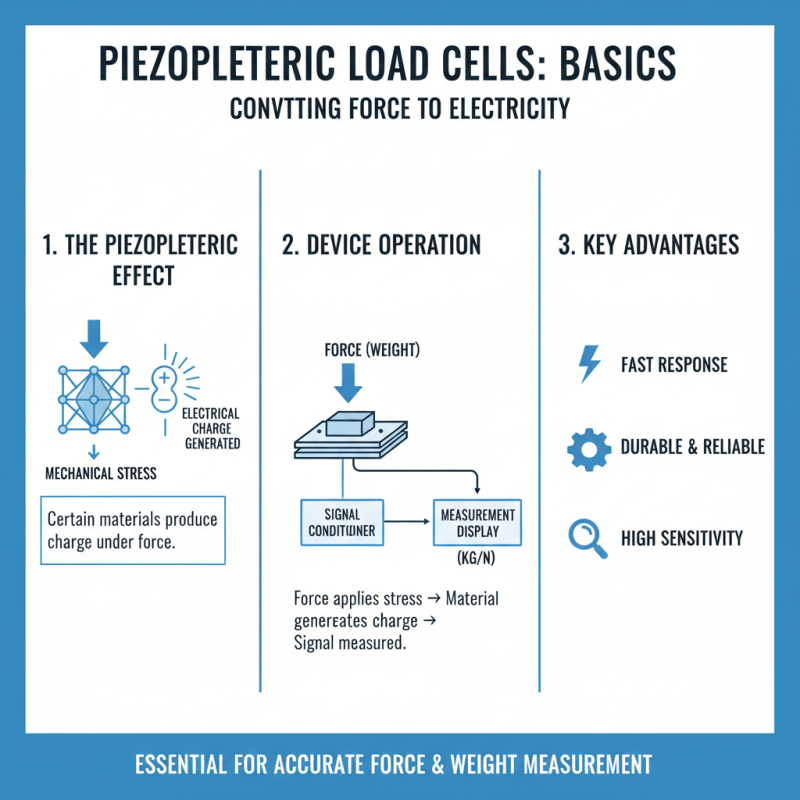
Piezoelectric load cells are essential devices for measuring force and weight. They operate based on the piezoelectric effect, where certain materials generate an electric charge under mechanical stress. This allows them to convert physical force into an electrical signal, which can then be accurately measured. Understanding how these devices work is vital for making informed choices.
When selecting a piezoelectric load cell, consider your application's specific requirements. Factors such as load capacity, frequency response, and environmental conditions play crucial roles. For instance, if you need to measure quick, dynamic loads, a load cell with a high frequency response is necessary. Additionally, think about the materials used in the load cell. Certain materials perform better in harsh environments.
Not all load cells are created equal. Variations in design can lead to differences in performance. Familiarizing yourself with the typical applications can help clarify your needs. Test different models if possible. It's also helpful to consult with experts for guidance. This directs you toward a solution that meets your needs effectively. Understand your application, and be prepared to ask questions.
Identifying Your Application Requirements for Load Cells
When selecting a piezoelectric load cell, understanding application requirements is critical. Various industries utilize load cells, including manufacturing, aerospace, and medical technology. According to data from a recent market analysis, over 30% of companies reported a mismatch between their load cell specifications and actual needs, leading to inefficiencies and increased costs.
Load cells measure force, weight, or pressure, making their specifications crucial. Factors such as load capacity, sensitivity, and temperature range must align with intended use. For instance, a study showed that temperature fluctuations can affect load cell performance by up to 25%. This highlights the need for careful consideration of environmental factors in selecting the right load cell.
Load cells can vary in formats, from miniature sensors for precise measurements to larger units for industrial applications. They also differ in output methods, either analog or digital. Understanding these nuances can prevent common pitfalls. A report indicated that 15% of companies faced issues due to improper selection. Ensure your choice matches your operational demands, or improvements might fail to meet expectations.
How to Choose the Right Piezoelectric Load Cell for Your Needs? - Identifying Your Application Requirements for Load Cells
| Application Type |
Load Range (lbs) |
Accuracy (%) |
Temperature Range (°C) |
Environmental Protection |
| Industrial Weighing |
0-1000 |
0.1 |
-10 to 50 |
IP67 |
| Laboratory Testing |
0-500 |
0.05 |
15 to 40 |
IP65 |
| Biomedical Applications |
0-100 |
0.01 |
10 to 37 |
IP54 |
| Automotive Testing |
0-2000 |
0.2 |
-20 to 60 |
IP68 |
| Aerospace Testing |
0-300 |
0.1 |
-40 to 70 |
IP67 |
Key Factors to Consider When Selecting Piezoelectric Load Cells
When selecting piezoelectric load cells, consider key factors that ensure optimal performance. One crucial aspect is sensitivity. High sensitivity allows for precise measurements, especially in applications involving low forces. Reports indicate that load cells with a sensitivity of 1 mV/V often provide better resolution in delicate weighing scenarios.
The temperature range is another important consideration. Piezoelectric load cells can be affected by temperature fluctuations. Choosing models that can operate effectively in a broad range, typically between -40°C to 85°C, is advisable. This ensures reliable measurements in various environmental conditions.
Another factor to note is the dynamic response time. Some applications require quick updates to maintain accuracy. Studies show that load cells with response times under 1 millisecond can significantly improve efficiency in high-speed operations. Evaluating these aspects can guide you in selecting a piezoelectric load cell that best aligns with your requirements.
How to Choose the Right Piezoelectric Load Cell for Your Needs?
This chart displays key specifications to consider when selecting a piezoelectric load cell. Factors such as load capacity, sensitivity, frequency response, and temperature range are essential for ensuring the load cell meets your specific requirements.
Comparing Different Types of Piezoelectric Load Cells
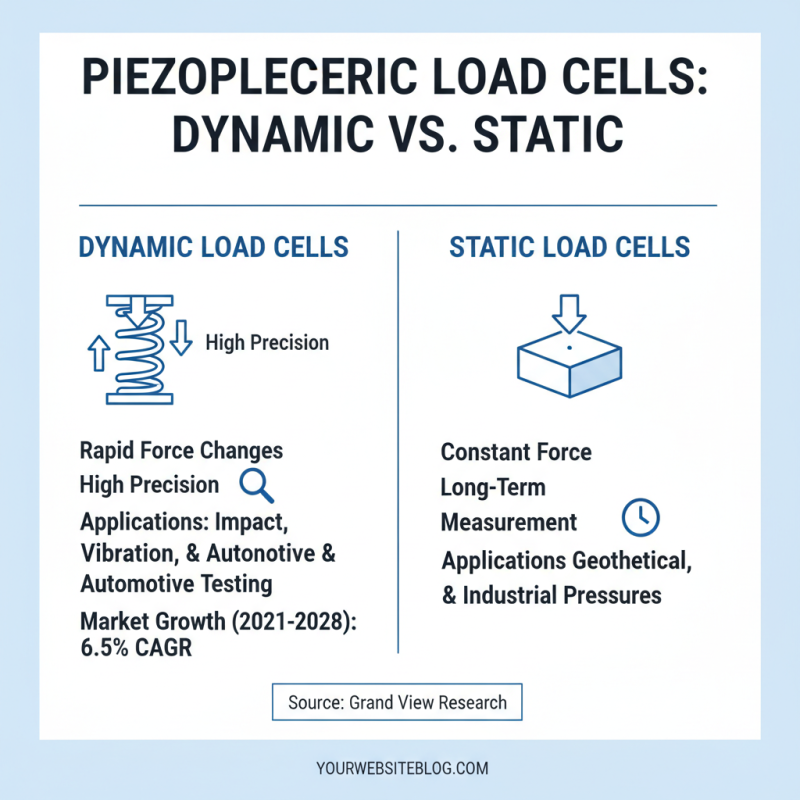
When selecting a piezoelectric load cell, understanding the various types available is crucial. There are two primary types: dynamic and static load cells. Dynamic load cells, designed for applications involving rapid force changes, often deliver higher precision in measurement. In contrast, static load cells excel in applications where forces are constant over time. According to a report by Grand View Research, the demand for dynamic load cells is projected to grow at a CAGR of 6.5% from 2021 to 2028. This growth underscores their importance in sectors requiring high-fidelity data.
Different configurations also influence performance. Uniaxial cells measure force in a single direction, while triaxial models capture forces along multiple axes. Each configuration presents unique advantages and limitations. Implementing triaxial load cells can provide comprehensive data, but they are often more complex to integrate. The average cost for dynamic models hovers around $500, while advanced triaxial units can exceed $1,500. Evaluating your specific needs against these cost factors is critical, especially in budget-sensitive projects.
Another aspect to consider is environmental suitability. Some piezoelectric load cells are designed for harsh conditions, while others may not withstand exposure to temperature fluctuations or moisture. Ensure the selected load cell meets your specific operational environment requirements. Neglecting this can lead to premature failure and compromised measurement accuracy. Balancing all these factors requires careful assessment and alignment with your operational goals.
Evaluating Manufacturer Specifications and Performance Ratings
When selecting a piezoelectric load cell, evaluating manufacturer specifications is crucial.
Performance ratings provide insights into a load cell's capabilities. For instance, a study by the International Society for Measurement and Control reported that
accuracy can vary by up to 5% among different models. This indicates the importance of choosing a device that meets specific precision requirements.
Manufacturer specifications often include maximum load, linearity, and hysteresis ratings.
These metrics help determine how well a load cell performs under various conditions. A reliable load cell should have a linearity specification of
less than 0.1%. Many applications may overlook these critical factors, leading to potential measurement errors.
Another critical factor is the temperature range. Load cells may perform differently in extreme conditions. A report indicates that
performance can degrade by 0.05% for every degree over an optimal range. This highlights the importance of understanding the operational environment before making a choice.
Evaluating these specifications empowers users to select the most suitable piezoelectric load cell for their specific needs.