How to Choose the Right Mini Piezo Siren for Your Needs?
Choosing the right Mini Piezo Siren can be challenging. These devices serve various applications, such as alarms and alerts. You must consider specific factors to ensure you select the best one for your needs.
Mini Piezo Sirens are compact and powerful. They generate loud sounds, alerting users effectively. However, different models vary in volume, pitch, and power consumption. Understanding these differences is essential.
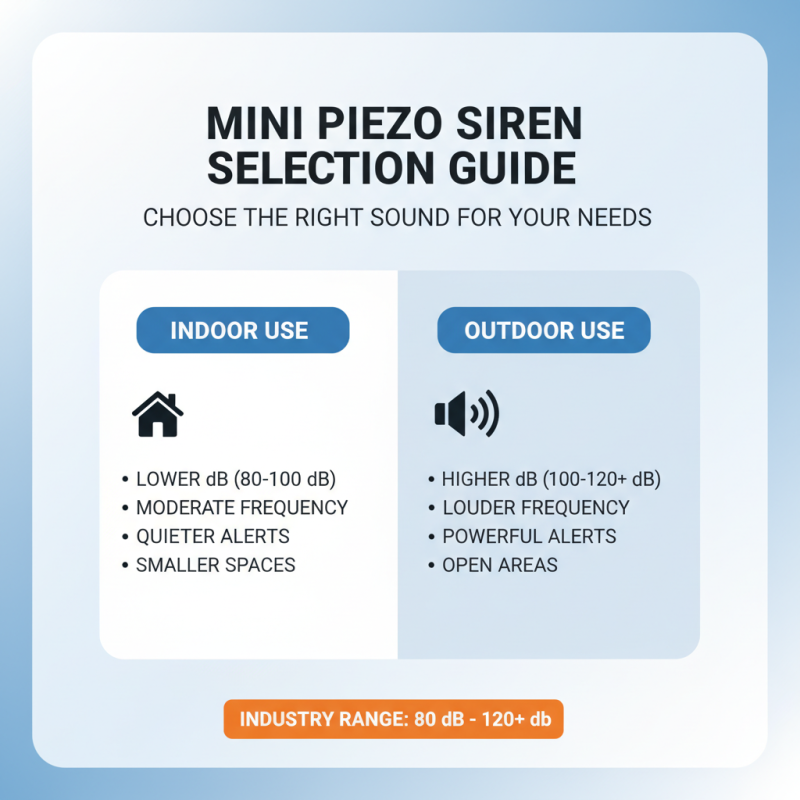
Additionally, think about where you will use the siren. Indoor versus outdoor settings require different specifications. Also, reflect on your budget. Some sirens are more affordable but may lack certain features. Selecting a Mini Piezo Siren involves careful thought and consideration. Make a list of your requirements and expectations to guide your choice.
Understanding the Basics of Mini Piezo Sirens
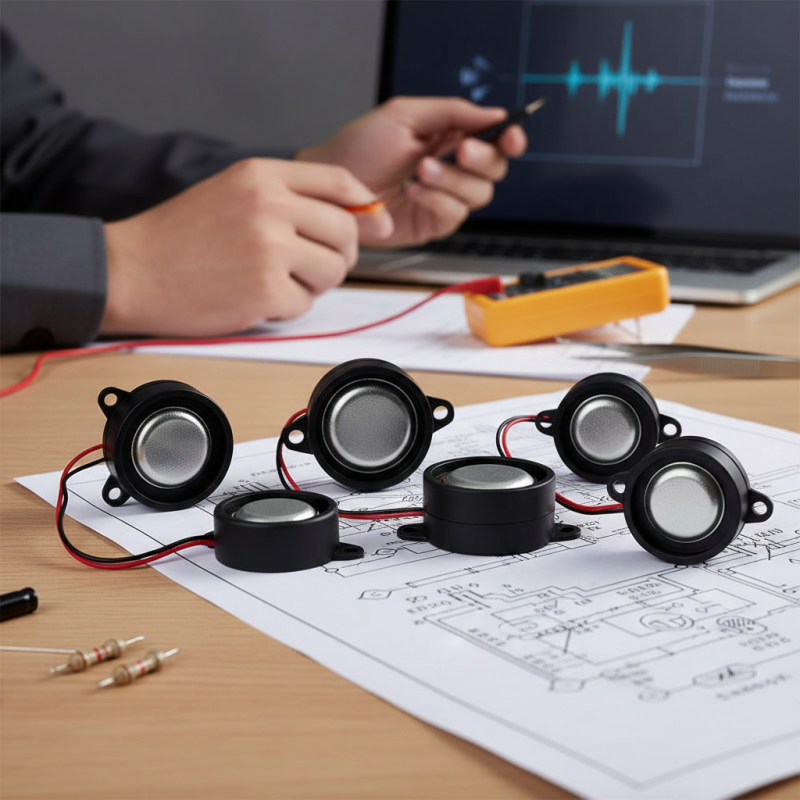
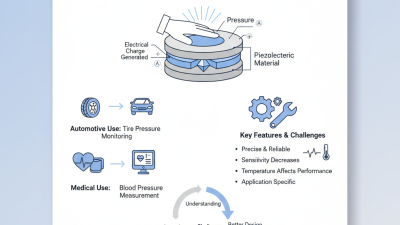
Mini piezo sirens are compact and versatile devices used in various applications. They convert electrical energy into sound, making them effective for alarms and alerts. Understanding their basics can help you pick the right one for your needs. These sirens generate sound through piezoelectric crystals, which vibrate when voltage is applied. This design allows for a loud volume without consuming much power, ideal for battery-operated devices.
When you consider a mini piezo siren, think about its sound output. Different sirens emit varying decibel levels. A siren with 110 decibels may provide a better alert than one with 85 decibels. Additionally, the tone matters. Some models produce a steady sound, while others create pulsating alerts. Depending on your needs, you might find yourself reflecting on which tone will effectively capture attention.
It's essential to consider the environment where the siren will be used. Factors like humidity, temperature, and potential exposure to dust can affect performance. An outdoor siren may require a more rugged design than one for indoor use. An often overlooked detail is the siren's installation. Depending on the available space, mounting options may impact functionality.
Identifying Your Specific Needs and Requirements
When selecting a mini piezo siren, it’s crucial to identify your specific needs. Different applications demand varying sound levels and frequencies. For example, a siren meant for outdoor use should have a higher decibel rating. Industry reports show that sound output can range from 80 dB to over 120 dB. Understanding these levels can guide you in making an informed decision.
Consider the environment where the siren will be used. Indoor settings may require softer sounds, while outdoor applications demand loud, penetrating tones. You might think that louder is always better. However, using a siren that's too loud for a confined space can create discomfort. It’s essential to balance sound output with the application context.
Another factor is power consumption. Some mini piezo sirens consume less energy, making them suitable for prolonged use. Research indicates that energy-efficient models can reduce power costs by up to 30%. Yet, it’s essential to weigh performance against energy savings. If the siren cannot produce sufficient volume, it may fail to serve its purpose. Reflecting on these trade-offs can lead to a more effective choice.
Comparing Different Types and Features of Mini Piezo Sirens
When selecting a mini piezo siren, it’s essential to consider various types and features available. Different designs serve unique purposes. For instance, some models focus on high decibel output, crucial for alarm systems. Reports indicate that a siren producing 100 dB can be effective within a radius of 50 meters. This is vital for ensuring alerts reach intended targets.
Another critical factor is the power source. Battery-operated sirens are convenient for remote areas. They typically offer portability but might require regular battery replacements. In contrast, wired models provide consistent performance but limit installation flexibility. Research shows that 65% of professionals prefer wired systems in fixed locations for their reliability. However, users must assess installation requirements and potential electrical hazards.
Durability is also a key consideration. Some mini piezo sirens are weatherproof, making them suitable for outdoor use. Still, this can lead to a trade-off in sound quality or range. Statistics reveal that more rugged models often sacrifice voice clarity to achieve their sturdy design. As you evaluate your options, reflecting on these aspects will guide you towards a suitable choice for your specific needs.
Evaluating Sound Output and Frequency Range Options
When selecting a mini piezo siren, evaluating sound output and frequency range is essential. Sound output is measured in decibels (dB). Most mini piezo sirens operate between 90 to 120 dB. A siren with 100 dB will alert most people effectively in an open area. However, in noisy environments, a higher output may be necessary for optimal performance.
Frequency ranges vary significantly. Typical ranges are between 1 kHz to 5 kHz. Higher frequencies tend to penetrate through background noise better. According to industry studies, sirens operating around 3 kHz can be heard over sounds like construction or traffic. Sound patterns also matter. A continuous tone may be more effective than a fluctuating one, especially in emergencies.
It's crucial to note that personal needs might differ. Consider the environment where the siren will be used. A higher frequency might not always be better. In some situations, lower frequencies may resonate more, reaching further distances. Reflections from buildings can distort sound. Testing in the actual space where the siren will be used is always recommended. This can help determine the ideal balance between sound output and frequency range.
Mini Piezo Siren Sound Output and Frequency Range
Assessing Durability and Environmental Factors for Your Choice
When choosing a mini piezo siren, durability is critical. Many factors affect how well a siren performs over time. Look for materials that resist wear. Plastics can be lightweight but may not stand up to harsh environments. Metal options can offer strength but may add weight. Consider where you will install the siren.
Environmental factors also play a significant role. For outdoor use, look for sirens with waterproof ratings. Dust and temperature extremes can cause problems. A siren might work fine in a lab but fail in the field. Wind and rain can affect sound projection. Always evaluate how the siren will hold up in its intended setting. It’s essential to think about these conditions before making a decision.
Sometimes, the siren might not meet all your expectations. Testing in different environments can reveal unexpected issues. This helps to refine your choice. A product that looks good on paper might perform poorly in practice. Addressing these real-world challenges is vital for your long-term satisfaction.
How to Choose the Right Mini Piezo Siren for Your Needs?
| Feature |
Option 1 |
Option 2 |
Option 3 |
| Sound Output (dB) |
105 dB |
110 dB |
115 dB |
| Operating Voltage |
5V |
12V |
24V |
| Temperature Rating |
-20 to 60 °C |
-30 to 70 °C |
-40 to 85 °C |
| Material |
Plastic |
Metal |
Composite |
| Protection Rating (IP) |
IP54 |
IP65 |
IP68 |
| Weight |
200 g |
300 g |
400 g |