






Beyond Touch: How BESTAR Ultrasonic Sensors Revolutionize Smart Cockpit Experiences
As intelligent driving evolves, the cockpit is no longer just a driving space but has transformed into "the third living space." User demands for cockpit interaction are shifting from "operable" to "more natural and safer." Ultrasonic sensors under Bestar Holdings have become the key technical enabler to solve scenario-based interaction pain points in smart cockpits, thanks to their millimetric ranging accuracy and anti-interference capabilities.
The "Cockpit Adaptability" Innovation of Ultrasonic Sensors
Different from traditional automotive sensors, BESTAR's custom-developed ultrasonic sensors for smart cockpits have achieved key breakthroughs in experience adaptability: millimetric ranging accuracy enables precise capture of subtle finger movements; wide-temperature design easily copes with extreme temperature changes in the cockpit from scorching summer heat to freezing winter cold; and exclusive anti-interference algorithms filter out background noises like air conditioning wind and seat adjustments, ensuring every interaction command is clearly recognized.
These experience upgrades are not empty talk — in actual tests by many leading new energy vehicle manufacturers, whether quickly switching navigation destinations or fine-tuning air conditioning temperature, the sensors can keep up with gesture movements with smooth and delay-free response. The misjudgment rate during continuous operations is almost negligible, making in-driving interaction as natural as daily hand waving.
Three Interaction Scenarios Redefine Cockpit Experience
Touchless Gesture Interaction: Bid Farewell to Safety Risks of "Looking Down to Touch"
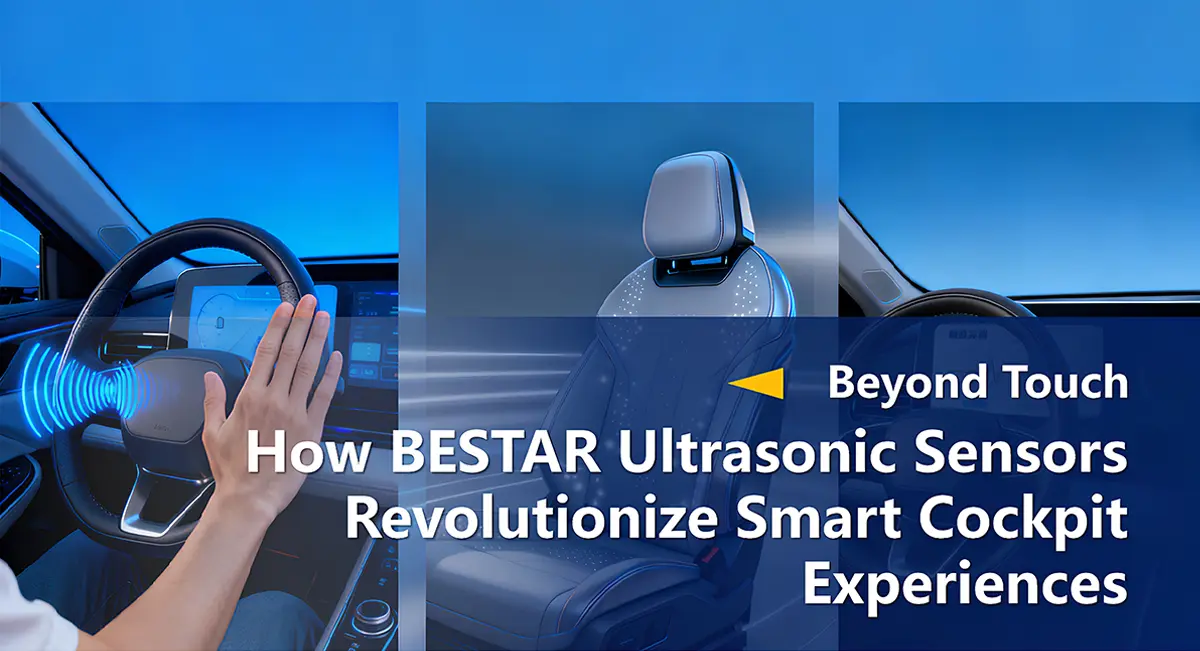
The moment you look down to operate the central control while driving often hides safety risks. Bestar ultrasonic sensors build an invisible 3D interaction field in the central control area. No need to reach out and touch the screen — a gentle wrist wave can change songs, adjust volume, or even zoom in/out navigation maps with an air swipe. Your eyes stay firmly locked on the road ahead, making every operation sync with the driving rhythm.
After a mid-size SUV model adopted this solution, many users feedbacked, "Finally, I don't have to distract myself looking for buttons to adjust the air conditioning while driving." In actual experience, the duration of视线 deviation during driving is significantly reduced. Central control operations are simplified from the tedious "find button-press" steps to the natural "raise hand-wave" movement, making the model's smart cockpit satisfaction rank among the best in its class.
Intelligent Seat Sensing: From "Passive Adjustment" to "Active Adaptation"
When you sit in the driver's seat, the seat seems to have a "mind-reading ability" — BESTAR's miniature ultrasonic sensors are hidden in the backrest and seat cushion, quietly identifying your body contour. They automatically adjust the backrest angle, seat cushion length, and even the headrest to fit the neck curve precisely. During long-distance driving, if you unconsciously lean forward for too long, the steering wheel will vibrate gently, accompanied by a voice reminder "Please take a break," resolving fatigue with thoughtful care.
In the user community of a leading new energy vehicle manufacturer, many long-distance self-driving enthusiasts shared: "I used to have backaches after driving for a long time, but now the seat will 'actively adapt'. Even when family members take turns driving, the seat can quickly adjust to the most comfortable position." This customized comfort experience has significantly improved seat adjustment satisfaction and reduced complaints about fatigue during long drives.
Health Status Monitoring: The Cockpit Becomes a "Mobile Health Station"
BESTAR has turned ultrasonic sensors into "health managers" in the cockpit. Without wearing any devices, sensors installed on the steering wheel or roof light strip can perceive your breathing and heartbeat through echo signals. If your heart rate is slightly rapid during traffic jams, the cockpit will automatically switch to soothing fragrance and gently ask via voice, "Would you like to play light music to relax?" making health care during driving silent yet warm.
Many users said after experience that this non-contact health monitoring is both considerate and non-intrusive. Especially when there are elderly or children in the car, their status can be monitored in real time, adding an extra layer of peace of mind to every trip. This "touchless yet warm" monitoring method is becoming a new trend in smart cockpits.
Sensors Are the "Experience Cornerstone" of Smart Cockpits
As smart cockpits become the core battlefield for automakers' competition, users' pursuit of "experience quality" is driving the continuous evolution of sensor technology. With its in-depth understanding of cockpit scenarios, BESTAR has transformed ultrasonic sensors from "technical components" into "experience carriers." Its products have entered the cockpits of many mainstream automakers, winning market recognition with customized sensing solutions.
From "mechanical buttons" to "voice interaction," and now to "touchless sensing," the evolution of smart cockpits essentially lies in the continuous improvement of "human-machine interaction accuracy." The application cases of BESTAR ultrasonic sensors prove that only by delving into scenario pain points and solving users' core needs of "safety, comfort, and health" through technological innovation can we seize opportunities in the wave of intelligent driving.
In the future, with the deep integration of sensors and AI algorithms, we may see even smarter cockpits — ones that can remember your preferences, perceive your state, and even predict your needs. And all of this will start with every precise "sensing moment."