






Defying Thermal Onslaught! BESTAR Holdings' Liquid Cooling System Activates "Turbo Cooling" for High-Load Mobile Devices
A leading tech giant recently unveiled its breakthrough mobile cooling solution—"CycloneCool Engine"—featuring an innovative hybrid liquid cooling + TEC air cooling architecture. Emphasizing four key advantages (massive airflow, ultra-compact size, superior waterproofing, and intelligent thermal control), this sets new direction for thermal management innovation.
As mobile performance demands surge (high-FPS gaming, 4K video, sustained 5G connectivity), device heat generation escalates dramatically. Under extreme outdoor conditions—high ambient temperatures plus direct sunlight—chip temperatures frequently exceed 45°C (113°F), causing discomfort, processor throttling, and accelerated battery degradation. Traditional passive solutions (graphene films, vapor chambers) approach physical limits in ultra-compact spaces, struggling against rising thermal loads.
This underscores the critical need for active cooling systems. By enabling dynamic thermal regulation, active solutions deliver superior heat dissipation and faster thermal response—essential for preventing performance loss and hardware damage in high-heat scenarios.
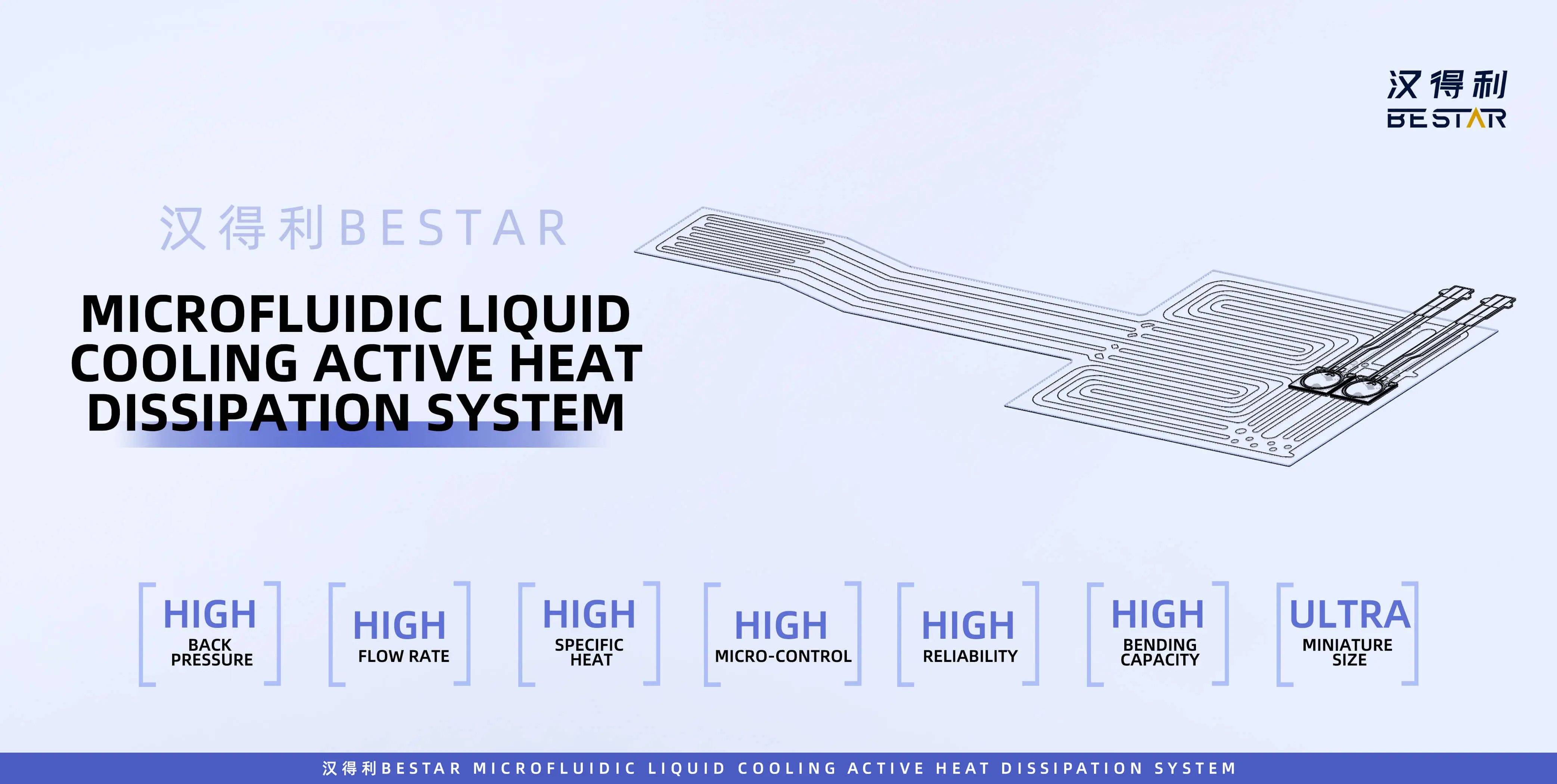
Addressing this challenge,BESTAR Holdings has innovated piezoelectric-based active cooling solutions for compact electronics:
- Microfluidic Liquid Cooling System
- Micro Piezoelectric Fan System
Both provide direct-source thermal management for smartphones and wearables.
Liquid vs. Air Cooling Explained
Liquid Cooling: Micro-channels constructed via layered architecture enable coolant circulation—driven by micropumps—that absorbs heat at the source, transports it to cooling zones, and returns cooled fluid. Leveraging sensible heat transfer, high specific heat capacity, and efficient air-fluid heat exchange, this enables precise temperature control, rapid cooling, and thermal uniformity.
Air Cooling: Relies on forced convection. Piezoelectric fans vibrate at kHz frequencies, generating directional airflow that accelerates surface heat dissipation via convection. Compared to natural airflow, piezoelectric fans boost heat transfer efficiency by 3-5×, making them ideal for space-constrained applications.
Today, we focus on BESTAR Holdings’ Microfluidic Active Cooling Solution.
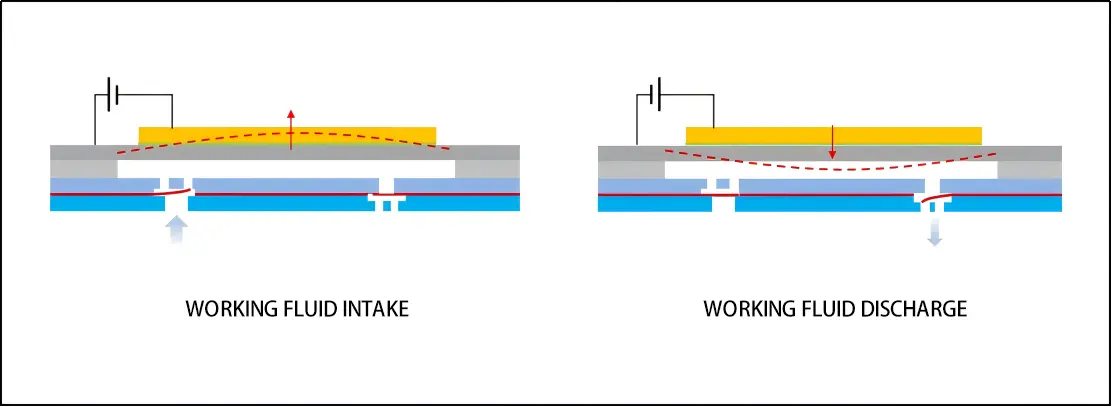
Piezoelectric Conversion: The Core Mechanism
A piezoelectric actuator(PZT ceramic bonded to metal diaphragm) powers the system. Under low-frequency AC voltage, the inverse piezoelectric effect triggers precise diaphragm oscillation. This motion coordinates with microvalves:
1.Intake Phase: Valve A opens → coolant drawn into pump chamber
2.Discharge Phase: Valve B opens → coolant pushed through microchannels
Sealed coolant loops efficiently transfer heat from hotspots to cooling regions and uniformly dissipate it through liquid-cooled membranes.
BESTAR Holdings’Microfluidic Active Cooling System employs this technology with proprietary piezoelectric micropumps, precision microfluidics, and high-performance coolants. Thermal imaging confirms exceptional performance:
- Drops surface temperatures by≈10°C (18°F)in just 2 seconds(50°C → 40°C/122°F→104°F)
- Achieves≈16°C (29°F) cumulative coolingwithin 20 seconds(down to ≈34°C/93°F)
- Maintains thermal uniformitywith≤1.5°C (2.7°F) varianceacross surfaces
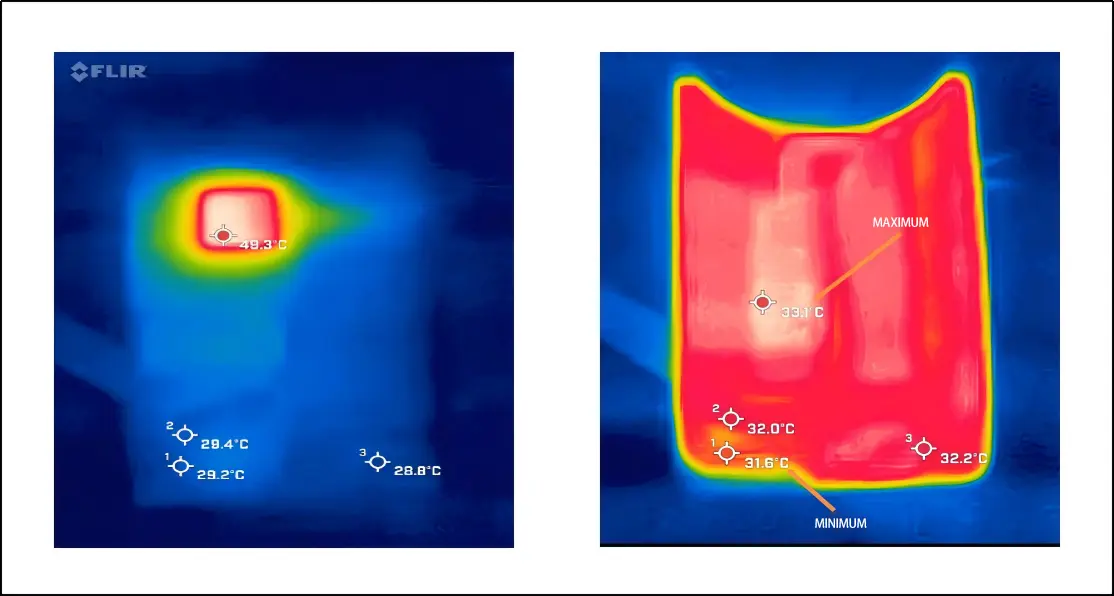
▲ Thermal Imaging Validation
With an ultra-compact footprint (< 49 mm²), this solution delivers active thermal control in premium micro-electronics. Its technological adaptability also extends to emerging needs in AR glasses, foldables, and ultra-thin laptops—where hybrid cooling becomes critical.
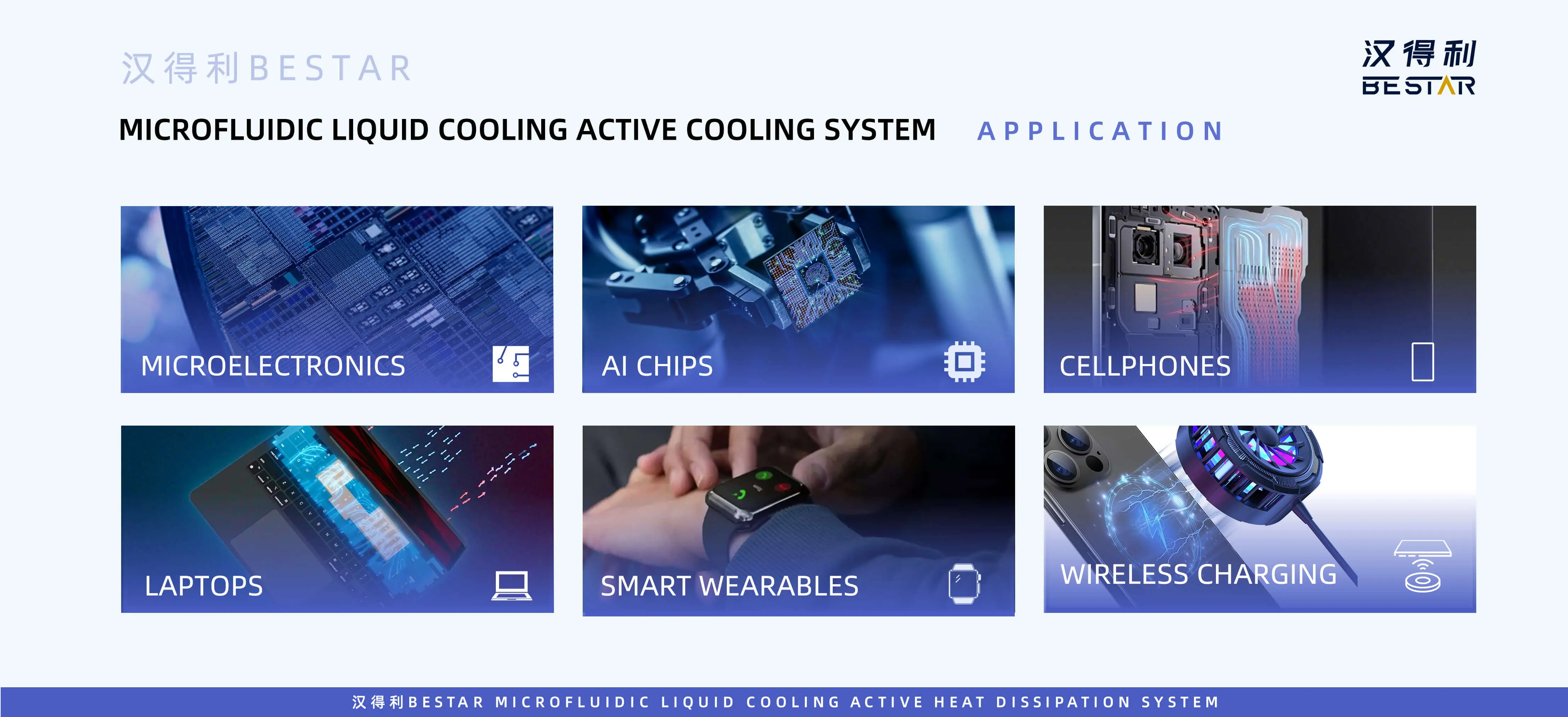
Industry forecasts indicate the global piezoelectric cooling market will exceed $2B within five years. Microfluidic active cooling won’t just unleash device performance ceilings—it will catalyze "actively-cooled smart devices"as a new product category. Merging precision actuation, fluid dynamics, and thermal science, this innovation is the core engine enabling thinner, cooler, and more powerful electronics.