






What is Acoustic Vehicle Alerting System (AVAS)?
1.What is AVAS?
2.How Does AVAS Work?
3.Why Is AVAS Important?
4.Conclusion
What is AVAS?
An Acoustic Vehicle Alerting System (AVAS) is an external system comprising the use of sound to be triggered in electric automobiles (EVs) and hybrids made up of electricity and gases (HEVs). It is meant to ensure that the sound of these silent cars can be heard by pedestrians and airline riders. The fact that EVs are silent and work at low speeds, which is dangerous because they may cause a safety risk, particularly in a city or close to pedestrian crossings. Acoustic vehicle alert system will overcome such a problem by synthesizing a sound that resembles an engine or producing an identity note, reminding people around about the presence of the vehicle.
The governments throughout the world have established stringent regulations, called Acoustic Vehicle Alerting Systems (AVAS), to secure the pedestrians. Regulation (EU) No. 540/2014 states that, as of July 1, 2021, all new electric or hybrid vehicles should have an Acoustic Vehicle Alerting Systems AVAS. The vehicle should have a system that automatically produces a sounding when the vehicle goes on at a speed of 20km/h and below or when it is being reversed. The tone and the loudness of the sound is varying with the pace, assisting the pedestrians in noticing the movement of the vehicle. Also in America, the FMVSS No. 141 had been issued by the National Highway Traffic Safety Administration (NHTSA): In this regulation, all electric and hybrid vehicles are obliged to emit an audible signal whenever vehicles are driven at 19 mph (30 km/h) or slower in velocity even when braking and reversing.
How Does AVAS Work?
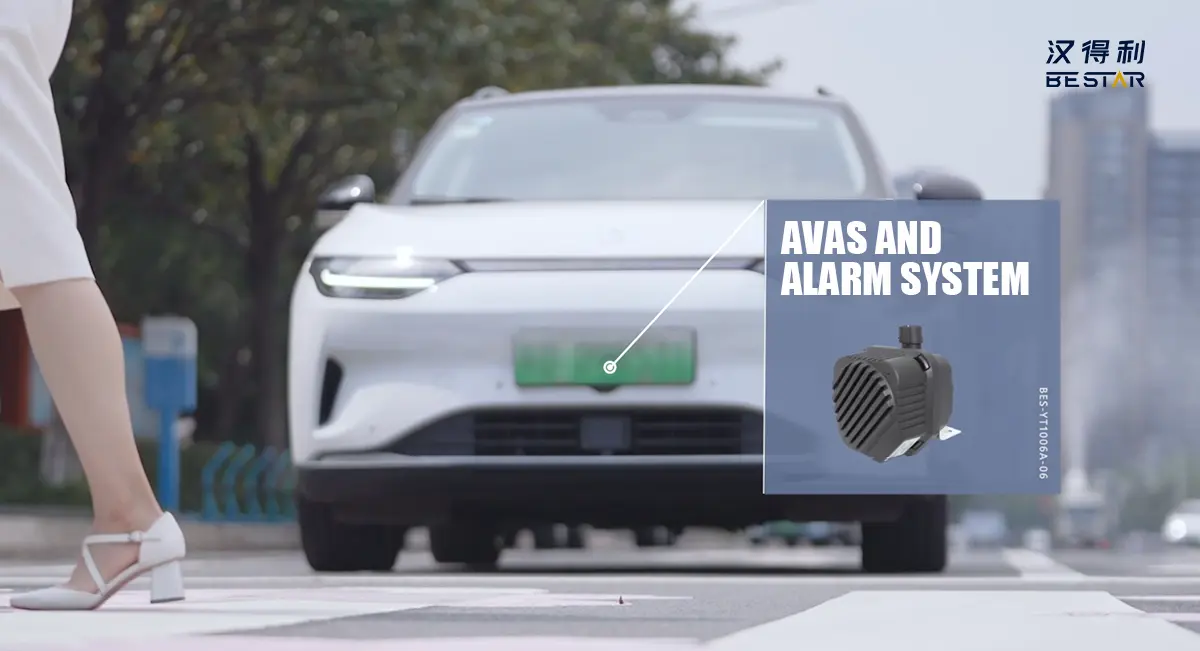
Acoustic Vehicle Alerting System AVAS is a solution in which a combination of sensors, a sound controller and external speaker . The system goes off automatically when the vehicle is moving at low speeds usually less than 20 km/h. It produces an artificial sound adjust to the driving situation as acceleration, braking, or reversing. The speakers installed either at the front or the rear of the car reflect the sounds to the pedestrians around. Sound profiles are adjusted to modulate the pitch and volume so that the people on the road could estimate the distance that the vehicle is and the speed at which the vehicle travels.
In some advanced systems, directional speakers or piezoelectric acoustic elements are used to regulate the precise manner of spreading sound. Different manufacturers customize AVAS sounds to customer needs as well as to their brand, and to attend to safety needs.
Why Is AVAS Important?
Recent reports concluded that electric and hybrid cars are more prone to low-speed crashes with pedestrians than traditional vehicles. This is because they are quiet to operation and hence difficult to hear in urban areas. The results highlight the significance of aural signals to avoid accidents. The Acoustic Vehicle Alerting System (AVAS) is a very important tool as it adds a sound alert to the blind pedestrians and bicycle users to ensure that they become aware of the coming electric vehicles and therefore, reduce road hazards among all users.
Acoustic Vehicle Alerting Systems AVAS also helps in controlling improved urban sounds. Rather than reintroducing the noise level of the combustion engines, it produces controlled delightful noises that make roads safe besides reducing general noise pollutants. This can assist cities in changing to the increased usage of electric vehicles without losing the acoustic comfort of the shared areas.
Conclusion
Acoustic Vehicle Alerting Aystem AVAS is not only a regulatory mandate but it remains an essential innovation, which can bring together three concepts: safety, technology, and sustainability. AVAS is a compromise between silence and consciousness, which makes electric vehicles come out safe and green. With the increased number of electric vehicles on the road worldwide, AVAS will be used to create the soundscapes of the new cities.
Looking for the suitable Acoustic Vehicle Alerting System (AVAS) solutions? Contact our team of engineers right now for advice and a quote.