Top Piezo Pressure Sensor Manufacturers for Global Buyers
Choosing the right Piezo Pressure Sensor manufacturer requires more than comparing catalog prices. Global buyers need dependable performance, clear documentation, and practical support after delivery. A sensor may face vibration, rapid pressure changes, high temperatures, or repeated mechanical stress. These conditions can expose weaknesses that product photographs never reveal.
This guide examines leading manufacturers through an engineering-focused lens. We consider sensing range, frequency response, sensitivity, housing materials, connector quality, and calibration practices. We also review factory experience, quality systems, customization capacity, and international communication. Qualified suppliers should provide detailed datasheets, inspection records, calibration certificates, and traceable production information. Their technical teams should explain installation limits without hiding important limitations.
Field experience shows that small details often matter. A poorly matched cable can weaken a strong measurement system. An unsuitable mounting surface can distort pressure readings. Buyers should confirm operating temperature, overload protection, signal conditioning, and amplifier compatibility before ordering. Compliance documents may also differ between regions, so verification remains essential.
No ranking is perfect. Manufacturer websites can omit failure-rate data, service delays, or application restrictions. Some impressive specifications may depend on controlled laboratory conditions. That deserves attention. Independent testing, sample evaluation, and direct technical questions can reduce purchasing risk. Cost still matters, but a cheaper sensor may create higher expenses through recalibration, downtime, or replacement. The manufacturers discussed here are assessed for technical credibility, manufacturing consistency, application knowledge, and support for international customers. The goal is practical guidance, not blind promotion, helping buyers make a more informed and defensible decision.
What Piezo Pressure Sensors Are and How They Work
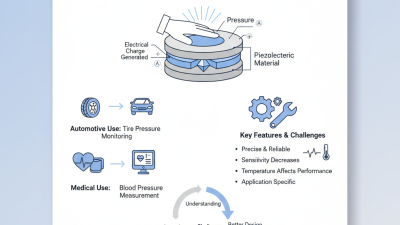
Piezo pressure sensors convert mechanical pressure changes into electrical charge. A diaphragm transfers force to a piezoelectric element, often made from ceramic or quartz. When pressure rises, the element deforms slightly and produces charge. The signal is usually tiny, but highly responsive.
These sensors excel at measuring dynamic events. Examples include combustion pulses, hydraulic impacts, shock waves, and rapid pressure fluctuations. They are less suitable for stable, long-term pressure readings. Charge gradually leaks through the sensor and cable. Static pressure can therefore appear to drift toward zero.
The sensing element connects to a charge amplifier or high-impedance voltage amplifier. This circuit converts the generated charge into a usable voltage signal. Cable selection matters. Long, poorly shielded cables may introduce noise from nearby motors or inverters. Installation also affects accuracy. Excessive mounting torque can preload the diaphragm, while loose mounting can create unwanted vibration.
Small details matter.
During equipment evaluation, I would check sensitivity, frequency range, temperature limits, sealing, and calibration records. A reliable supplier should explain these values clearly and provide traceable test data. In field work, testing the sensor with a known pressure pulse can reveal wiring or mounting errors. I have found that even a technically excellent sensor can perform poorly when the mounting surface is uneven. That limitation deserves honest attention.
Key Specifications for Comparing Piezo Pressure Sensors
Top Piezo Pressure Sensor Manufacturers for Global Buyers
Key Specifications for Comparing Piezo Pressure Sensors
When comparing piezo pressure sensors, start with the measuring range and pressure type. Piezoelectric sensors suit rapidly changing pressure, impacts, combustion pulses, and vibration. They are usually unsuitable for steady static pressure. A sensor rated for 1,000 bar may still fail under repeated shock loading. Check sensitivity in pC/bar or mV/kPa, not only the maximum range. That difference matters.
Frequency response reveals how accurately the sensor captures a fast pressure event. Review the lower cutoff, upper limit, and resonant frequency. A wider bandwidth often improves transient measurements. Mounting changes the result. Thread size, sealing method, torque, and adapter material can alter the signal. I once treated mounting hardware as a minor detail. The measured pulse became visibly distorted.
Temperature range deserves equal attention. Confirm operating temperature, thermal sensitivity, insulation resistance, and overload capacity. Ask for calibration data at conditions close to your application. Cable length and connector quality also affect noise, especially near motors or ignition systems. Laboratory specifications can look excellent. Field wiring may tell a different story. Verify the sensor with a known pressure source before full deployment. Record zero output, repeatability, and signal stability after several heating cycles. A small drift may be acceptable, but unexplained drift needs investigation.
Top Piezo Pressure Sensor Manufacturers for Global Buyers
Key Specifications for Comparing Piezo Pressure Sensors
The chart presents representative, non-brand-specific upper measurement ranges commonly used when comparing piezoelectric pressure sensors. Piezo sensors are primarily designed for dynamic pressure, vibration, combustion, shock, and transient measurements rather than long-term static pressure monitoring. Actual specifications vary by sensor construction, pressure port, signal conditioner, and operating temperature.
Leading Piezo Pressure Sensor Manufacturers Worldwide
Leading piezo pressure sensor manufacturers worldwide serve automotive, aerospace, industrial, and research applications. Their products measure fast pressure changes, shock waves, combustion pulses, and hydraulic transients. Piezoelectric elements respond quickly, but they are generally unsuitable for long-term static pressure measurement.
MarketsandMarkets reported that the global pressure sensor market could grow from about USD 14.8 billion in 2023 to USD 21.9 billion by 2028. This expansion increases demand for reliable dynamic sensing. Buyers should compare charge-output and IEPE designs, frequency range, sensitivity, overload resistance, and operating temperature. A practical test may involve a 0–10 bar pulse line, vibration exposure, and repeated calibration checks. Small details matter.
Leading manufacturers usually provide traceable calibration, ISO-certified production systems, and application engineering support across regions. Aerospace users may require high-temperature assemblies near 250°C, while factory systems often prioritize compact connectors and easy replacement. Grand View Research has identified industrial automation and automotive electronics as important growth areas for pressure sensors. Still, market reports often combine piezoresistive, capacitive, and piezoelectric technologies. That limits direct comparisons. Buyers should request raw performance data, calibration uncertainty, sealing materials, and documented lifecycle testing before approving a supplier.
How Global Buyers Can Evaluate Manufacturers and Suppliers
Global buyers should evaluate piezo pressure sensor suppliers beyond price and catalog range.
A 2024 Fortune Business Insights report estimates continued growth in the global piezoelectric devices market, driven by industrial monitoring, medical equipment, and automotive systems. Growth increases choice, but it also increases supplier risk. Ask for complete datasheets, pressure-range graphs, sensitivity tolerance, operating-temperature limits, and noise performance. A credible manufacturer should explain test conditions clearly.
Quality evidence matters more than polished presentations.
The ISO Survey 2023 recorded more than 1.2 million ISO 9001 certificates worldwide, showing how common quality certification has become. Certification helps, but it does not prove sensor accuracy. Request recent calibration records, measurement uncertainty, equipment identification, and sample test results. Confirm whether calibration is traceable to recognized national or international standards. Also examine change-control procedures, failure analysis, and production-batch records.
Supply continuity needs practical testing.
Review lead times, minimum order quantities, packaging methods, export documentation, and replacement policies. Ask for three production samples, not only one demonstration unit. Compare their readings under vibration, temperature cycling, and repeated pressure loads. Small differences may reveal weak bonding or unstable electronics. No checklist is perfect. A supplier may pass an audit yet struggle during a sudden material shortage. Include a pilot order, written acceptance criteria, and a second-source plan before approving large volumes. A clean factory floor is useful evidence, but it is not final proof.