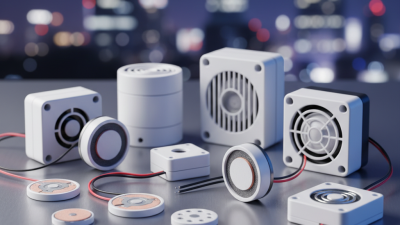
Choosing a reliable Piezo Diaphragm supplier is not simply a price comparison. It is a technical decision affecting sound output, product life, assembly consistency, and customer trust.
Dr. Kenji Uchino, a recognized piezoelectric technology expert, states, “Mechanical stress becomes electrical charge; electrical energy becomes motion.” This principle appears in every diaphragm application, from compact alarms and medical devices to industrial sensors. A supplier must therefore understand more than basic material specifications. Electrode design, ceramic thickness, resonance frequency, capacitance, adhesive quality, and protective coating all influence real performance.
Small differences matter.
A diaphragm may look identical in a catalog yet produce a noticeably weaker tone after repeated operation. Humidity, temperature changes, mounting pressure, and incorrect drive voltage can expose weaknesses quickly. Experienced buyers should request test reports, tolerance data, sample history, and production details before approving a supplier. Factory audits or video inspections can reveal practical issues, including inconsistent bonding, poor packaging, or unclear traceability.
This guide evaluates ten Piezo Diaphragm suppliers for global buyers. The comparison considers manufacturing experience, customization capability, quality control, export readiness, technical support, minimum order quantities, and communication reliability. It also recognizes an uncomfortable reality: no supplier is ideal for every application. A low-cost source may suit a simple buzzer, but not a medical or safety-related device requiring strict consistency.
Specifications can mislead.
The strongest choice is the supplier that matches the buyer’s operating conditions, verification process, and long-term risk tolerance. Our ranking is a useful starting point, not a substitute for testing.
A piezo diaphragm is a thin vibrating element that converts electrical energy into sound. It usually combines a piezoelectric ceramic layer with a metal diaphragm. When voltage changes, the ceramic bends and creates audible vibration. The result can be a compact buzzer, alarm, sensor, or feedback device.
Supplier selection matters because small material differences can change the final sound. Buyers should check diameter, resonance frequency, capacitance, sound pressure, operating voltage, and temperature range. A reliable supplier provides measured test data, stable production records, and clear tolerance limits. Samples should be tested inside the intended housing, not only on a laboratory bench. Mounting pressure can alter frequency. Adhesive thickness can also reduce volume.
Experienced buyers should ask how suppliers control ceramic bonding, electrode quality, and batch consistency. Traceable inspection reports make technical discussions more useful. Compliance documents should match the destination market and product application. Delivery performance matters too, especially when a diaphragm supports a finished device launch. A low price may appear attractive, yet weak documentation can create expensive delays. I would still question any supplier promising perfect uniformity across every batch. Real manufacturing has variation. Good suppliers measure it, explain it, and control it within practical limits. Calibration methods, packaging protection, and responsive engineering support often reveal more than a polished quotation.

Global piezo diaphragm sourcing starts with a measurable specification, not a supplier shortlist. Define sound pressure level, operating frequency, capacitance, diameter, thickness, and drive voltage. State the working temperature range too. A diaphragm tested at 25°C may behave differently inside a sealed alarm or humid control panel.
MarketsandMarkets estimates the piezoelectric devices market will grow from about USD 35.2 billion in 2023 to USD 51.5 billion by 2028, with a 7.9% CAGR. This expansion increases supplier variety, but it can also increase specification confusion. Request frequency-response curves, impedance data, acoustic output at a stated voltage, and batch-to-batch tolerance. Do not accept “high sensitivity” without test conditions. That phrase is too vague.
Material selection needs equal attention. Ask whether the ceramic uses lead-based or lead-free formulations, and request declarations for applicable chemical requirements. Review ISO 9001 certification, incoming-material controls, aging tests, and traceability records. The IPC-1752A framework can help organize material declarations, although it does not replace legal review.
Keep samples and production parts under the same test method. This is often missed. A lower-cost part may pass a basic sound test yet fail after temperature cycling. Define packaging, minimum order quantity, tooling ownership, inspection standards, and acceptable defect limits before requesting quotations. Some requirements will change after testing. That is normal, and ignoring the change is the real mistake.
| Rank | Supplier Profile | Core Capability | Typical Product Format | Common Diameter Range | Typical Frequency Range | Common Substrate | Customization Fit | Documentation to Request | Best-Fit Buyer | Key Qualification Check |
|---|---|---|---|---|---|---|---|---|---|---|
| 1 | Profile A — High-Volume Manufacturer | Automated piezoelectric diaphragm production and stable repeat orders | Buzzer elements, sounders, and alarm diaphragms | 12–50 mm | 1.5–10 kHz, application-dependent | Brass or stainless-steel shim with ceramic disc | High for dimensions, terminals, lead wires, and resonance targets | Material declarations, dimensional report, electrical test data, RoHS/REACH statement | Global OEMs requiring consistent monthly supply | Verify process capability, annual capacity, and lot-to-lot frequency consistency |
| 2 | Profile B — Custom Acoustic Specialist | Design support for sound pressure, impedance, and resonance optimization | Open or enclosed piezo sounder elements | 15–41 mm | 2–6 kHz typical for audible alarms | Brass, nickel-plated steel, or stainless steel | Very high for acoustic targets and housing integration | Frequency response curve, SPL test conditions, impedance data, drawing approval | Alarm, security, appliance, and control-panel manufacturers | Confirm test distance, drive voltage, mounting fixture, and measurement standard |
| 3 | Profile C — Sensor and Transducer Supplier | Piezoelectric sensing, excitation, and low-power signal applications | Bare diaphragms and wired sensing assemblies | 10–35 mm | 500 Hz–20 kHz, depending on design | Brass, stainless steel, or polymer-backed metal | High for sensitivity, capacitance, and cable configuration | Sensitivity data, capacitance tolerance, insulation resistance, aging results | Industrial sensing and condition-monitoring equipment buyers | Request sensitivity tolerances under the actual mounting and temperature conditions |
| 4 | Profile D — Miniature Component Producer | Small-form-factor piezo elements for compact electronic devices | Miniature discs, rings, and leaded elements | 8–25 mm | 2–15 kHz typical | Thin brass or nickel-plated steel | High for thickness, lead length, adhesive, and packaging | 2D/3D drawings, packaging specification, solderability data, inspection plan | Compact appliances, handheld devices, and control modules | Check minimum order quantity, breakage rate, and automated visual inspection |
| 5 | Profile E — Industrial Reliability Supplier | Long-life components for continuous-duty industrial equipment | High-durability diaphragms and protected assemblies | 20–50 mm | 1–8 kHz typical | Stainless steel or nickel-plated steel | Medium to high for environmental protection and mounting | Reliability test report, temperature cycling, humidity testing, traceability records | Industrial alarms, instrumentation, and factory automation | Define duty cycle, operating temperature, humidity, vibration, and storage life |
| 6 | Profile F — Rapid-Prototyping Supplier | Small-batch development, sampling, and engineering change support | Standard discs and prototype custom parts | 10–50 mm | 1–20 kHz, depending on geometry | Brass, stainless steel, or flexible metal shim | Very high for prototypes and low-volume variants | Prototype inspection report, sample approval record, material certificates | Startups, laboratories, and product-development teams | Confirm sample-to-mass-production continuity, tooling ownership, and lead time |
| 7 | Profile G — Medical and Instrumentation Supplier | Controlled production for diagnostic and measurement equipment | Low-noise diaphragms and application-specific assemblies | 10–40 mm | 500 Hz–10 kHz typical | Medical-grade stainless steel or coated metal | High for cleanliness, traceability, and controlled assembly | Quality manual, lot traceability, change-control procedure, biocompatibility data where applicable | Medical, laboratory, and precision-instrument manufacturers | Clarify whether the supplier supports the buyer’s regulatory and validation requirements |
| 8 | Profile H — Harsh-Environment Supplier | Protection against moisture, dust, vibration, and temperature variation | Sealed sounders and coated diaphragm assemblies | 16–45 mm | 1–6 kHz typical | Stainless steel or corrosion-resistant plated steel | High for sealing, coatings, connectors, and mounting geometry | Ingress-protection evidence, corrosion test results, vibration test data, operating limits | Outdoor equipment, transport systems, and industrial control panels | Request test conditions rather than relying only on an IP or environmental rating |
| 9 | Profile I — Cost-Optimized Export Supplier | Standardized products with competitive pricing and export packaging | Standard piezo discs, buzzers, and basic wired elements | 12–50 mm | 1.5–8 kHz typical | Brass or plated steel | Medium for standard specifications and packaging changes | Commercial invoice, packing list, origin documents, RoHS/REACH statement, inspection report | Distributors and high-volume buyers with stable specifications | Compare total landed cost, payment terms, packaging protection, and defect allowance |
| 10 | Profile J — Integrated Module Supplier | Diaphragm, housing, driver, connector, and final assembly integration | Ready-to-install sounder or sensor modules | 15–50 mm assembly size | 1–10 kHz typical | Metal diaphragm with ABS, PC, or engineered polymer housing | Very high for electrical, mechanical, acoustic, and packaging integration | Complete drawing, control plan, end-of-line test record, reliability report, change notification process | Buyers seeking fewer assembly steps and simplified supplier management | Validate system-level performance, serviceability, tooling responsibility, and second-source options |
International piezo diaphragm sourcing requires more than comparing unit prices. A reliable supplier should provide clear data on resonance frequency, capacitance, sensitivity, diameter, thickness, and operating temperature. Ask whether these values come from controlled tests or simple estimates. Ask for evidence. Small details matter.
Request production samples before approving large orders. Measure sound pressure, frequency stability, bonding strength, and current consumption under your actual working conditions. A supplier with practical engineering experience should explain test methods, fixture limits, and acceptable variation. It should also support design changes without hiding behind a fixed catalog. I have found that sample results can differ from datasheets, especially after humidity exposure. That difference deserves investigation, not excuses.
Evaluate manufacturing consistency through batch records, inspection reports, and traceability codes. Check how the supplier controls ceramic materials, electrode coating, curing temperature, and final packaging. Moisture-resistant packaging is important when diaphragms cross oceans or remain in warehouses. Confirm lead times, minimum order quantities, replacement procedures, and export documentation in writing. Communication quality is another useful signal; delayed answers during technical review may become serious delays during production. Certifications can support credibility, but they should match the factory’s actual scope and current processes. A polished certificate alone proves little. Supplier audits, independent testing, and a signed quality agreement create stronger protection for international buyers.
The ten leading piezo diaphragm suppliers serve different technical priorities. High-volume manufacturers compete on stable capacitance, fast tooling, and automated inspection. Custom specialists focus on resonance tuning, electrode patterns, and compact acoustic chambers. According to MarketsandMarkets’ 2024 piezoelectric devices report, automotive, healthcare, and consumer electronics remain major demand sectors. These sectors require repeatable output, not merely low prices. Supplier strength therefore depends on process control, material traceability, and documented test methods.
Several suppliers stand out through ceramic formulation expertise. Others provide flexible polymer diaphragms for thin alarms and wearable products. Some maintain regional production close to appliance and automotive assembly plants. This reduces transport time and simplifies engineering changes. Grand View Research reports continued expansion in the global piezoelectric materials market, supported by sensing, actuation, and acoustic applications. However, market figures differ by scope. That inconsistency deserves attention.
Experienced buyers should request frequency curves, impedance data, aging results, and samples from multiple lots. A reliable supplier should explain bonding temperature, protective coating limits, and failure analysis procedures. Certifications help, but they do not replace production evidence. The strongest ten suppliers usually offer application engineering, controlled customization, and supply continuity during demand swings. No supplier is perfect. A cheaper diaphragm may create louder assembly noise, unstable resonance, or higher rejects. In practice, the best choice balances acoustic performance, qualification speed, and total ownership cost.
Choosing among piezo diaphragm suppliers requires more than comparing unit prices. Request a complete cost sheet, including tooling, minimum order quantities, testing, packaging, freight, and replacement terms. A low quote may hide high setup charges. World Bank Commodity Markets Outlook data shows continued volatility in industrial input prices, so ask how long each quotation remains valid. Compare prices at the same volume, frequency range, diameter, capacitance, and sound-pressure target.
Compliance should be verified with documents, not promises. Ask for material declarations, restricted-substance statements, traceability records, and recent test reports. The ISO Survey 2022 recorded more than 1.26 million ISO 9001 certificates worldwide, but certification alone does not prove process control. Check the certificate scope and audit date. For export orders, request clear evidence of conformity with applicable product and chemical requirements. Small gaps matter.
Delivery performance needs measurable evidence. The World Bank’s Logistics Performance Index 2023 evaluates customs, infrastructure, tracking, and timeliness across 139 economies. Ask suppliers for historical lead-time data, not optimistic estimates. Confirm sample timing, production capacity, safety stock, and recovery plans. Technical support should include impedance curves, frequency-response data, mounting guidance, and failure analysis. A responsive engineer can prevent cracked ceramics or weak bonding. I would still test samples in the final housing. Lab performance can change after assembly. Specification sheets are useful, but they are not the whole product.